

Why creative learning matters
Education is often associated with textbooks, explanations and written assignments, but some forms of learning become more powerful when students can work with their hands. Creative activities give students the opportunity to test ideas, make decisions and learn from the result immediately. Graffiti is particularly effective in this context because it combines visual culture with a practical technique that is unfamiliar to most students.
A graffiti workshop can introduce students to contemporary art while also creating space for experimentation. Instead of being asked to produce a single correct answer, students work through a process in which choices about letters, colours, shapes and composition influence the final result.
Graffiti as a practical art lesson
Graffiti is often recognised as part of urban culture, but a closer look reveals a wide range of artistic principles. Letter structure, proportion, spacing, contrast, colour and composition all play an important role in a finished piece. These ideas can be explored naturally during a workshop because students see the effect of each decision directly on the surface.
Read More : Strengthening Organizational Success Through Leadership Development
A professional workshop can begin with a short introduction to graffiti and its cultural background before moving into spray-paint techniques. Students learn how distance and movement affect a line, how different caps change the spray pattern and how layers of colour can build a stronger image.
From letters to personal expression
Lettering provides a useful starting point because it gives students something familiar to work with. A name or word can be transformed into a visual composition by changing the shape of the letters and adding outlines, shadows and colour. This process introduces students to the idea that written language can also function as a visual image.
At the same time, graffiti leaves room for personal expression. Two students can receive the same instructions and still arrive at very different results. One may prefer large block letters, another may experiment with flowing forms, while someone else may be more interested in colour or characters. The structure of the activity is shared, but the outcome remains individual.
Learning through experimentation
Spray paint rewards experimentation because its results are immediate. A student can change the distance from the surface, alter the speed of movement or try another cap and immediately see the difference. This creates a direct connection between action, observation and adjustment.
That process is valuable in education because mistakes become part of the learning rather than simply something to avoid. Students can test an approach, recognise what did not work and adapt it. The surface records that process visibly, making improvement easier to see.
Collaboration and shared artwork
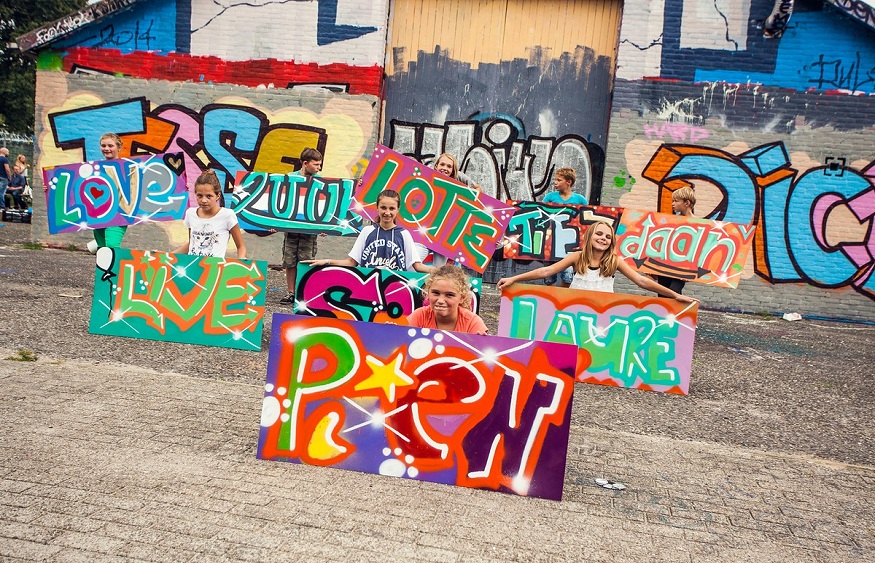
Graffiti can also turn an individual art exercise into a collaborative project. Students may work on separate panels or contribute to one larger composition. In the second case, decisions about colour, scale and space become shared decisions, and students have to consider how their own work fits alongside that of their classmates.
A large collective mural can therefore teach a simple but useful lesson about collaboration. Everyone has an individual contribution, but the overall result depends on how those contributions work together. This makes a graffiti workshop relevant not only to art education, but also to broader project-based learning.
More than an art technique
Students can gain more from a graffiti workshop than the ability to use a spray can. The activity can introduce visual communication, contemporary urban culture and design thinking in a format that feels different from a conventional classroom lesson.
Graffiti also provides an opportunity to discuss the difference between legal street art and unauthorised graffiti. Understanding where graffiti comes from, why artists use certain styles and how public space is involved gives students cultural context rather than presenting spray painting as an isolated craft.
This combination of practical work and cultural background is important. Students are not simply copying a visual style; they are learning why the style exists and how artists use it to communicate identity and ideas.
Why professional guidance makes a difference
The presence of an experienced artist can make the activity much more effective. Students receive practical instruction before using the materials and can ask questions as they work. The artist can also help students develop their own ideas instead of turning the workshop into a demonstration in which only the instructor produces the final work.
For schools considering an educational graffiti workshop, the strongest format is one in which technique, cultural context and creative freedom support each other.
Graffiti fun world form the Graffiti fun company, is the largest global graffiti workshop provider in the world and the ultimate digital platform connecting talented artists with premium street art opportunities worldwide. Backed by two decades of industry leadership, Graffiti fun world seamlessly bridges the gap between client events and professional graffiti creators through an innovative, proprietary workshop program. From high-impact corporate teambuilding and private group sessions to custom-commissioned murals, the platform empowers a global network of artists while delivering accessible, top-rated street art experiences on a global scale. Graffitifunworld provides school graffiti workshops internationally, combining cultural introduction, supervised spray-painting and creative work.